
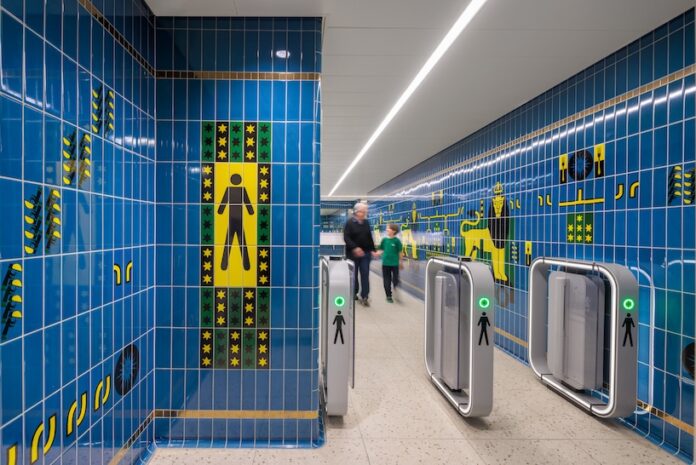

Hugh Broughton Architects’ redesign of the Piccadilly Circus and Green Park facilities prioritizes accessibility and inclusivity
Two stations, one design approach
Westminster City Council has reopened refurbished public toilets at Piccadilly Circus and Green Park Underground stations, both designed by Hugh Broughton Architects. The two stations are a single stop apart on the Piccadilly line, and together they serve as a gateway to Soho, Regent Street, the West End theatres, Mayfair, and St. James’s. They also provide access to the area’s grand hotels and restaurants, such as The Ritz, The Wolseley, and Fortnum & Mason, as well as Green Park itself.
As explained here, the reopenings are the third and fourth completed schemes in the council’s program to upgrade eight public toilets across Westminster, following the award-winning refurbishments at Victoria Embankment and Parliament Street. Millions of residents, commuters, and visitors use these stations every year, so the quality of the facilities matters.
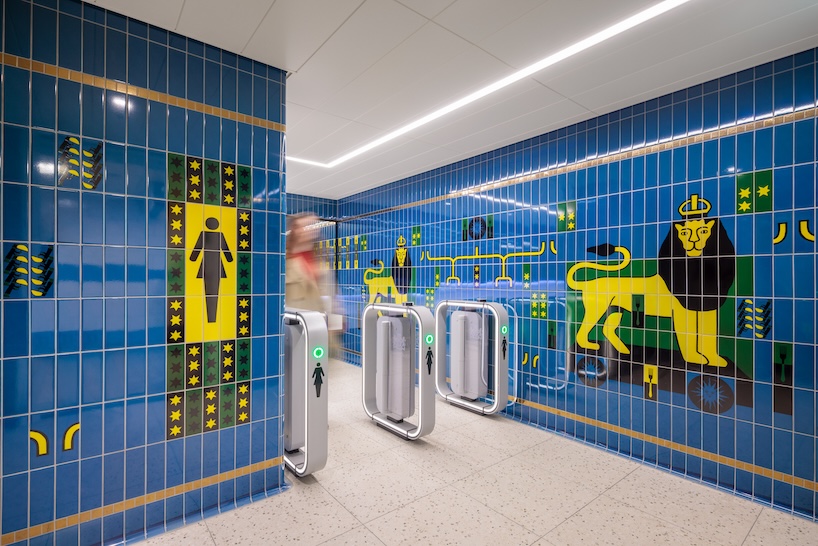
The look is consistent across all four sites. Glossy “Westminster Blue” tiles line the walls, and gold cubicles have become the series’ signature.
Built for everyone
Each scheme is an early adopter of Part T of the Building Regulations, which sets larger minimum cubicle sizes than before. The facilities include:
- ambulant cubicles
- enlarged cubicles with baby-changing facilities
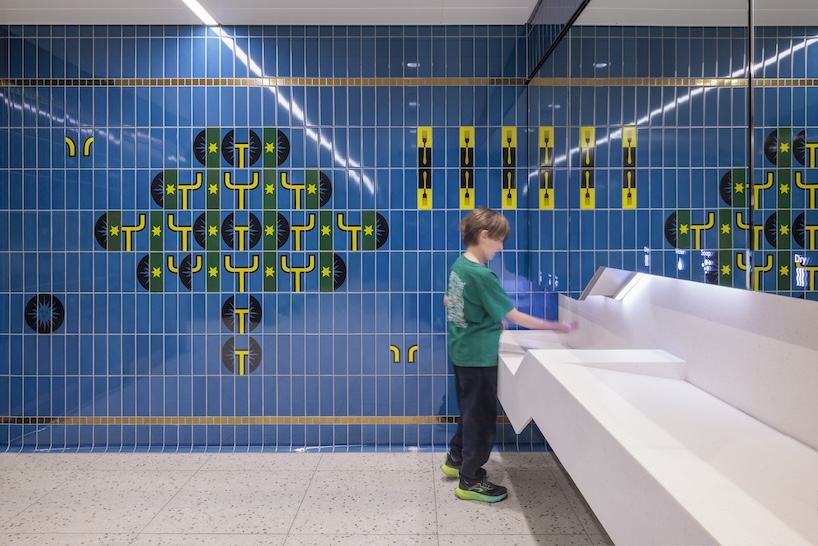
- lowered sinks for younger users
Layouts are planned for clear sightlines, with no dark corners, which makes the spaces feel and be safer. The result is a practical answer to what inclusive, secure public infrastructure should look like.
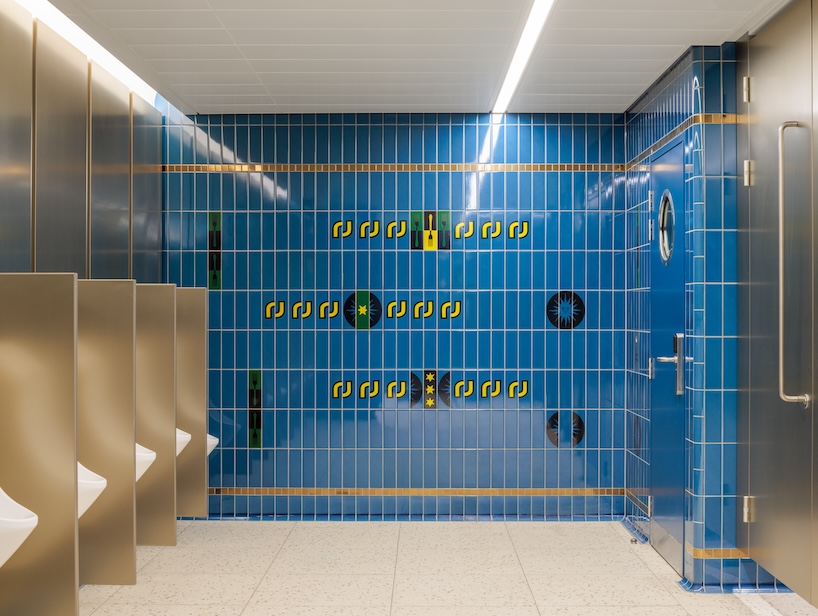
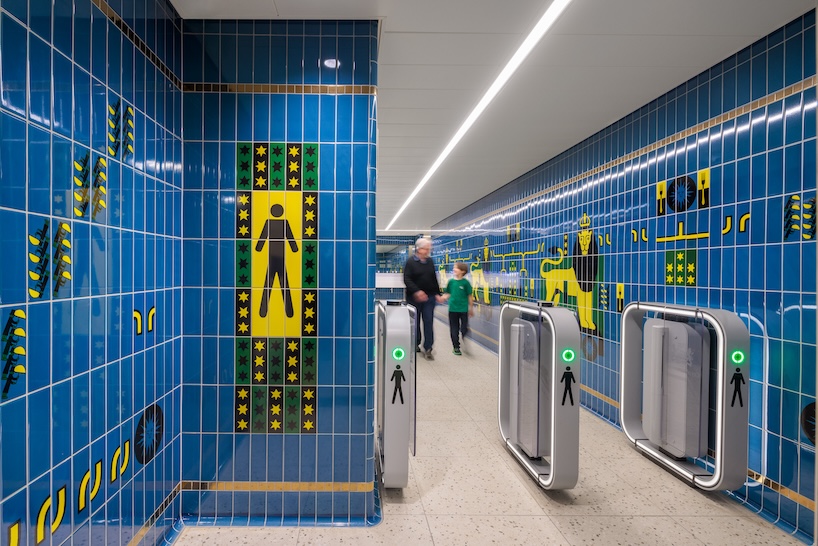
Piccadilly Circus: pink columns and pixel patterns
Piccadilly Circus was the harder site. The station’s radial geometry and its many structural steel columns, which carry the streets and buildings overhead, forced the architects to impose order on an awkward footprint so that the space is easy to navigate.
Charles Holden’s original design put the men’s and women’s facilities on opposite sides of the ticket hall. The new layout brings them together in a more welcoming arrangement. The exposed columns are painted a vivid pink, picking up the palette of James Lambert’s artwork and tying the interior to the character of Piccadilly.
Lambert’s illustrations celebrate the energy and spectacle of the Circus. The statue above the junction, so often called Eros, actually depicts his brother Anteros, god of requited love, and the statue’s arrow is the central motif. Swirling lines echo the nearby Art Deco buildings and suggest rhythm and performance. Motifs from theaters, music halls, and cinemas recall the district’s entertainment history, while dot-matrix patterns and pixel shapes nod to the illuminated billboards that have lit the skyline for more than a century.
Green Park: rebalancing the layout
At Green Park, the original provision leaned heavily toward men. The redesign rethinks the entrances and corrects the imbalance, so the facilities are fairer and more welcoming from the moment you arrive. A wheelchair-accessible toilet has also been added, preparing the facilities for the day the station itself becomes fully step-free.
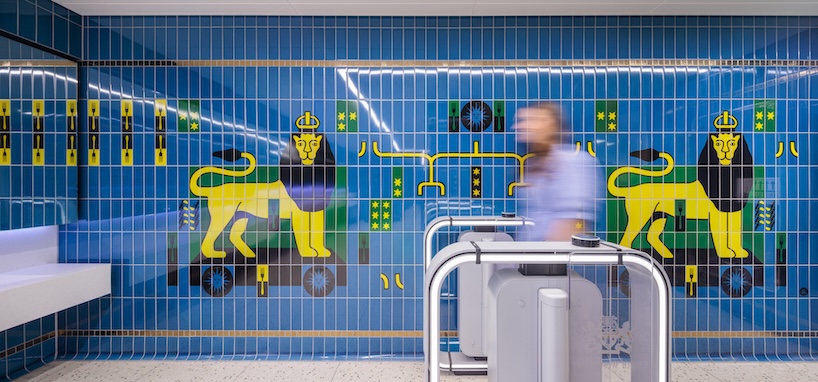
Lambert’s artwork here reflects the layered character of one of London’s most refined neighborhoods:
- Lions on toy cars refer to the sculptures on top of the Canada Gates.
- Forks pay tribute to the area’s afternoon tea institutions.
- Yellow links allude to the nearby jewelry trade.
- A central building recalls a folly once built in the park.
- Doormen with umbrellas evoke the grand hotels.
- The scattered stars are daffodils, which carpet the park each spring.
Weaving such detailed artwork into the architecture was one of the project’s most demanding and rewarding aspects.
The team
Westminster City Council appointed FM Conway as a delivery partner. FM Conway brought in Hugh Broughton Architects to lead the design at each site, with engineers from Harley Haddow. The Contemporary Art Society’s consultancy manages the artistic partnership, and M&M Moran is the construction partner. Lambert’s illustrations appear on the bespoke Westminster Blue tiles, made by H&E Smith and screen-printed by Digital Ceramics.