




A sustainable solution
Concrete underpins modern civilization—nearly every construction project globally relies on it. Yet this ubiquitous material carries a hidden cost: cement production, its primary binder, ranks among the world’s largest sources of carbon emissions.
The problem with cement
Creating cement requires heating and processing limestone at high temperatures, generating enormous quantities of CO₂. For years, researchers have sought alternatives to reduce this environmental burden.
An unexpected solution
As explained here, scientists at Manipal University Jaipur, led by civil engineer Raghuvesh Tiwari, may have found a breakthrough. Their innovation transforms two environmental challenges into one solution: using biochar derived from human waste to partially replace cement in concrete.
According to their research published in Scientific Reports, this approach yields remarkable improvements in concrete performance while repurposing a material humans generate constantly—about 400 grams per person daily across the globe.

How it works
Biochar, a carbon-rich material created by heating organic matter in oxygen-starved conditions, can be made from numerous feedstocks. In this case, fecal sludge from treatment plants undergoes pyrolysis (heating to 350–450°C) to produce a fine powder that substitutes for a portion of traditional cement.
Testing the concept
The research team tested concrete mixes replacing 5%, 10%, and 15% of cement with fecal biochar. The results surprised them:
- At 5% replacement: Concrete achieved optimal strength, absorbing less water and showing reduced shrinkage compared to conventional mixes. After 91 days of curing, compressive strength increased by 20% and flexural strength by 36%.
- At 10% replacement: Improvements intensified—21% gain in compressive strength and 42% in flexural strength, while maintaining comparable performance in water absorption and porosity.
- At 15% replacement: Strength continued building but fell short of the lower percentages, suggesting an upper limit to biochar effectiveness.

Why it works
The mechanism involves three complementary processes:
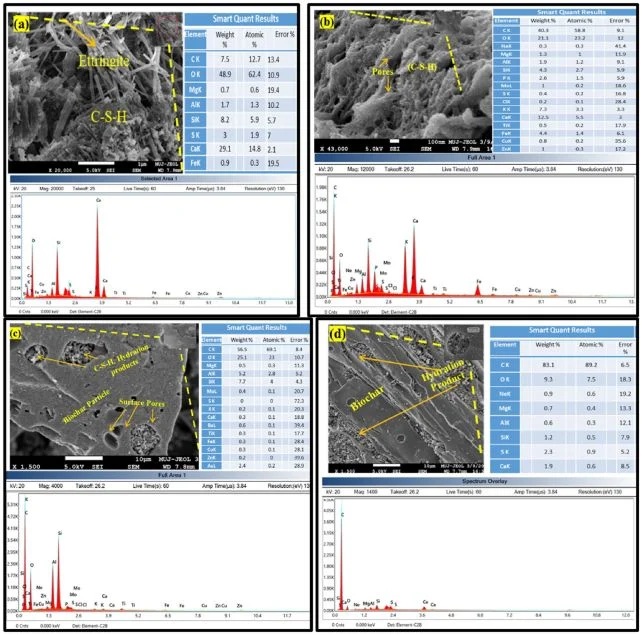
- Water retention: Biochar’s porous structure acts as a microscopic reservoir, gradually releasing water during curing to sustain the chemical reactions that strengthen concrete.
- Chemical bonding: Biochar contains silica that reacts with cement compounds to form calcium silicates—the same principle used in ancient Roman concrete, which famously remains durable millennia after construction.
- Structural density: Fine biochar particles fill microscopic gaps, creating denser, more tightly bonded concrete structures visible under microscopy.
What remains unknown
While promising, the research leaves important questions unanswered. The study didn’t measure the actual carbon reduction achieved, nor did it test performance under real-world conditions like freeze-thaw cycles or extreme temperatures.
A critical concern involves heavy metals, which accumulate in sewage sludge. Whether these metals remain locked within the concrete or leach into the environment over time requires further investigation.
The bigger picture
Full-scale adoption remains distant, but the concept addresses a compelling logic: humans produce human waste in limitless quantities, and waste treatment plants already operate globally. Converting this unavoidable byproduct into a material that simultaneously strengthens concrete and reduces cement demand tackles two environmental problems simultaneously—precisely the kind of circular economy solution modern construction desperately needs.