


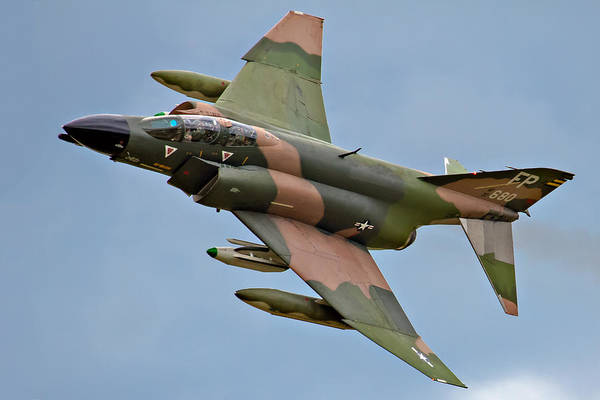

How a legendary fighter jet failed its pilots in the most human way
The McDonnell Douglas F-4 Phantom II, which entered service with the US Navy in 1960, became one of the most widely adopted jet fighters of its era. By the mid-1960s, it was integral to the air operations of the Navy, Marine Corps, and Air Force alike. The 1972 F-4E variant introduced leading-edge wing slats that dramatically enhanced maneuverability at high angles of attack, though this came at the cost of reduced top speed.
Technical upgrades and combat refinements
As explained here, the F-4E represented a significant evolution from the F-4D, featuring more powerful J79-GE-17 engines and the addition of an M61A1 “Vulcan” 20mm cannon—a direct result of lessons learned during the Vietnam War. To accommodate these upgrades without increasing weight, engineers removed the hydraulic wing-folding mechanism and emergency ram-air turbine while adding a seventh fuel cell. Later variants incorporated self-sealing fuel tanks for enhanced survivability, though these consumed 139 gallons of capacity.
The hidden cost of long-distance flight: Bathroom access
What official specifications rarely mentioned was the extreme physical challenge posed by extended missions in the F-4E. David Weinberg, a former USAF Weapon Systems Officer (WSO), tells the ordeal of a 13-hour flight from Hickam AFB in Hawaii to Osan Air Base in South Korea—a mission that highlighted one of the aircraft’s most uncomfortable realities.
The layers problem
The greatest difficulty wasn’t fuel consumption or navigation; it was managing basic biological needs while trapped in multiple protective layers. Flying over the frigid Pacific Ocean in February required pilots and WSOs to wear thermal underwear, anti-exposure suits, flight suits, survival vests, inflatable life vests, and g-suit pants—a complete cocoon of protective gear. When nature called, removing enough layers to use a piddle pack became a grueling ordeal.
Weinberg candidly notes that he required five piddle packs during the 13-hour journey. The process of unbuckling his lap belt, partially standing in the cramped rear cockpit, and maneuvering through multiple layers of cold-weather gear made what should be a simple task into a logistical nightmare. As he humorously understates it, “getting through all the layers regardless of how ‘well endowed’ you were” was genuinely challenging.
Hydration and nutrition trade-offs
Interestingly, staying hydrated was manageable—but Weinberg deliberately limited his fluid intake to minimize bathroom trips. Rather than eat substantial meals, he relied on snacks stored in his g-suit pockets and pre-packaged “box nasty” rations positioned on side consoles. This calculated self-deprivation became a survival strategy in the tiny rear cockpit.
The F-4E Phantom II was an engineering marvel that revolutionized air combat, but it was woefully inadequate when it came to creature comforts on marathon missions. Despite the indignity of the experience—and despite swearing “never again” upon landing—Weinberg’s lasting memory remains affectionate: “I loved that plane and still miss those days.”